How to hire remote developers from India in 2026
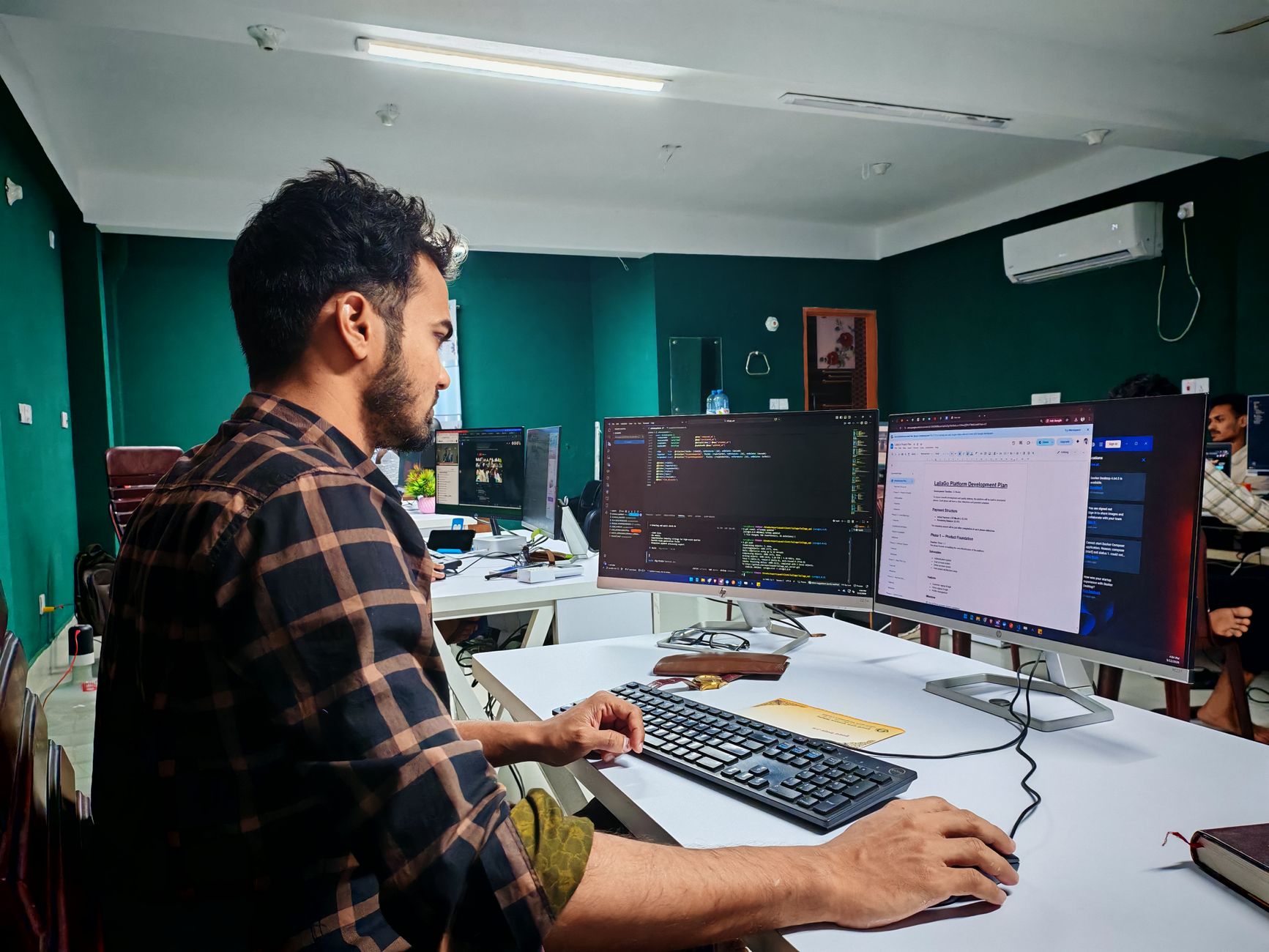
How to hire remote developers from India in 2026
To hire remote developers from India in 2026, define the scope tightly, vet for AI-native fluency (Cursor, Claude Code, Copilot), pay weekly instead of monthly, and structure the first week as a paid trial so a wrong match costs one week of work, not three months. India still has the deepest English-speaking developer pool in the world. The bottleneck has shifted from sourcing to vetting and contract structure.
Most founders we talk to already know India is the answer. They're stuck on the part nobody writes about: how to tell, in two interviews and one trial week, whether the engineer in Bengaluru can actually ship without a senior holding their hand.
Why India is still the obvious answer in 2026
The numbers are unchanged from last year and they still favor India. The country has roughly 5.8 million working software developers and graduates another 1.5 million engineers every year. Top-5% English fluency is comparable to FAANG-tier US engineers. AWS, GCP, and Azure all have multiple India regions; latency from Mumbai to US East is around 220ms, which is fine for any developer workflow that isn't pair-programming over screen-share at 4K.
Time-zone overlap is better than most US founders assume. From Indian Standard Time (IST), you get roughly 3 to 4 hours of overlap with European mornings and 1 to 3 hours with US East Coast late afternoons. That is enough for a daily 30-minute sync window plus 6 hours of overlapping focus time on either side.
The story has changed in one specific way. The bar for "good enough" has moved. Every credible hire in 2026 ships with Cursor or Claude Code in their daily flow. If your candidate doesn't, they're competing against Indian engineers who do, at the same price. Skip the ones who don't.
The default failure mode (why most India hires go sideways)
Most founders following the conventional advice make the same four mistakes.
They source on Upwork by lowest hourly rate. A $12/hr developer is sometimes a junior who will grow. More often it is an account farmed by an agency that will swap engineers behind your back. The Job Success Score gates we wrote about in our Upwork hiring playbook catch most of these, but only if you use them.
They go through an offshore agency that bills $40-$60/hr while paying the engineer $8-$12/hr. The misalignment shows up in week three when the engineer has no incentive to push back on bad scope, because they're not the customer. You are. They report to their account manager.
They sign a 30 to 90 day contract with no exit clause. A bad match in week two costs you the rest of the contract. Founders write angry Slack messages and pay anyway because the alternative is litigating across borders.
They skip the paid trial week. The interview is not the job. We've seen engineers ace four hours of LeetCode and then ship 11 lines of code in their first sprint. We've also seen the reverse. Trial weeks are how you find out.
What you actually have to vet for in 2026
The vetting funnel everyone publishes (resume, LeetCode, system design, culture chat) is fine. It is also incomplete. Here is what the top 10 SERPs miss.
Cursor / Claude Code / Copilot fluency
Ask: "Show me a PR you opened this week using Cursor agent mode or Claude Code. Walk through what you typed, what the model produced, what you rejected, and what you kept." A fluent engineer will share their screen and narrate for ten minutes without preparation. A pretender stalls inside 30 seconds.
This is the single highest-signal interview question for India hires in 2026. Engineers who use AI tools daily ship two to three times more tickets per week than equivalents who don't. The gap is wider for remote engineers, because there's no senior physically nearby to unblock.
Prompt-as-spec discipline
Show the candidate a Linear ticket. Ask them to draft the Cursor prompt they would run first. You're looking for: explicit context (which files matter), constraints (what not to touch), acceptance criteria, and a verification step. If they jump straight to writing code, they have not yet internalized the way modern AI-assisted development works.
Async written communication
Send the candidate a one-page brief by email. Ask for a written response with three questions and a proposed scope. Score on three things: did they spot the ambiguous requirement, did they cut scope or expand it, and is their written English clear enough to be read by your investors?
A good Indian developer in 2026 writes Slack messages a US founder can paste straight into a board update. The bad ones translate from Hindi or Tamil syntax and require three rounds to clarify. The first hour of writing reveals which group you're hiring.
Working laptop test
Open the candidate's editor on screen-share. Ask them to navigate a real codebase they own. Watch the keyboard shortcuts, the test runner, the git workflow. Real workflows show fast. People who say they use Cursor but actually use VS Code Copilot will be exposed in 60 seconds.
Where to source: 6 channels, honestly compared
Each of these works for some founders. None of them work for all founders. Pick by your real constraint: speed, cost, or commitment.
| Channel | Typical cost | Time to onboard | Exit cost | Best for |
|---|---|---|---|---|
| Upwork | $15-$60/hr | 1-3 weeks | Low (project-based) | One-off scoped jobs |
| Toptal | $60-$120/hr (~$2.4-$4.8k/wk) | 1-2 weeks | 2-week notice | Senior contractors with US polish |
| Turing / Arc.dev | $3k-$8k/month | 1-2 weeks | Monthly | Full-time-equivalent placements |
| Offshore agency | $30-$60/hr blended | 2-4 weeks | 30-90 day notice | Whole-team builds |
| LinkedIn direct + your contract | $2k-$8k/month | 4-8 weeks (you DIY) | Whatever you wrote | Long horizon, in-house feel |
| Cadence (weekly booking) | $500-$2k/week | 48-hour trial | End any week | Founders who want to start shipping this week |
A few honest notes on this table.
Toptal is genuinely good for senior contractors and their screening is the toughest in the industry. You pay for it. If your work is six months of senior architecture, Toptal is reasonable. If it's a 4-week feature push, the markup is hard to justify.
Turing and Arc.dev are closer to managed full-time placement than weekly contracting. They want your role to be 40 hours per week for six months. That fits some teams. It doesn't fit founders running 6-12 week experiments.
Offshore agencies make sense if you need a whole team at once. A frontend engineer, a backend engineer, a QA, and a project manager from one agency, scoped to one project, is a real shape. The trade is that you don't pick the engineers individually and you carry the agency's overhead.
Cadence is the weekly-booking option. Every engineer on the platform is AI-native by default; we vet on Cursor, Claude Code, and Copilot fluency through a founder-led voice interview before any engineer unlocks bookings. The trade against Toptal is breadth versus polish: our 12,800-engineer pool has more mid-tier specialists than Toptal but fewer ex-FAANG staff engineers.
If you're hiring for a shorter horizon and want to skip the recruiter loop, find a vetted remote engineer in 2 minutes on Cadence and run the 48-hour trial before you commit to anything weekly.
What it actually costs in 2026
Honest 2026 numbers, not aspirational ones.
Standard contractor monthly rates from India:
- Junior (0-2 years): $1,000-$2,000/month
- Mid-level (3-5 years): $2,500-$4,500/month
- Senior (6-10 years): $4,500-$7,500/month
- Staff / principal (10+ years): $7,500-$12,000/month
Recruiter fees on full-time hires: 15-25% of first-year salary, which works out to $4,000-$8,000 for a typical India FTE.
Cadence weekly tiers (for comparison):
- Junior, $500/week: cleanup, dependency hygiene, doc-writing, integrations with good docs
- Mid, $1,000/week: standard features, end-to-end shipping, refactors, test coverage
- Senior, $1,500/week: owns scope, architecture work, complex refactors, performance, edge cases unprompted
- Lead, $2,000/week: architectural decisions, complex systems design, fractional CTO, scale
The weekly model is not always cheaper, especially if you keep an engineer for 12+ months. It is always lower-commitment. A bad month with a contractor costs you the contractor's monthly rate plus a notice period. A bad week on weekly billing costs you one week.
If you want to model it more precisely for your actual roadmap, our cost frameworks for DevOps engineer salaries in 2026 walk through how the same conversion math applies in a different specialty.
How to onboard so the first week ships code
The single biggest determinant of whether a remote India hire works out is what the founder does in the first 72 hours after the contract is signed. Specifically:
Pre-signing: get the development environment ready. A prod-cloned dev environment, repo access, Linear or Jira account, Slack channels created, and a Loom of "here's our codebase in 5 minutes" recorded. None of this should be the engineer's job to set up.
Day 1: pair the engineer with a pre-scoped first ticket. Small enough to merge by Friday. Big enough to require touching at least 3 files and writing at least one test. This is the trial. If they ship it well, you have the answer.
Daily 1:1 the first week. 15 minutes, written first then voice if needed. Sample prompt: "What did you ship yesterday, what are you blocked on, what context do you need from me before EOD my time?"
Treat AI-native self-onboarding as a baseline. Modern engineers point Claude Code at the repo and have a working mental model in two days. If your hire is asking you for a 90-minute architecture walkthrough, that is a signal, and not a positive one. Cadence engineers hit a 27-hour median time to first commit, which is roughly what you should be benchmarking against in 2026 regardless of where you source.
Performance management when they sit 12 hours away
The traditional "are they at their desk" question doesn't apply. Here is what does.
Daily ratings or written status with shipped artifact. Every working day, the engineer posts: what shipped (link the PR), what is blocked (tag the blocker), what they need (specific ask). 4 sentences. No essays.
Weekly retro. What shipped, what slipped, what is the next week's bet. 30 minutes on Friday or Monday. The bet should be specific: "I will land the Stripe webhook refactor and the two flaky tests by Thursday."
Don't measure hours. Measure shipped tickets per week. Hour-tracking software produces false signal. Linear velocity is the real number.
Replacement should be fast and non-punitive. This is where weekly billing structurally beats long contracts. If the match isn't working in week 2, you end the booking and try a different engineer. With a 6-month contract, you and the engineer both know they have to last 6 months, which warps the working relationship in week 4.
What to do this week
If you're starting from zero, the path is shorter than it looks.
- Write the spec. One page. What is the problem, what does success look like in 4 weeks, what tech stack, what tier of engineer. If you can't write this, no platform on earth will help you.
- Pick one channel and run one paid trial week. Don't spread across four platforms. You'll have four parallel half-hearted conversations and no shipped code.
- Vet on AI-native fluency live. Screen-share, real workflow, real codebase. Skip anyone who can't.
- Pay weekly, not monthly, for the first month. This is true on every platform that supports it. Optionality is worth 10-20% of the rate.
If you want to compress steps 2 and 3 into 48 hours, the fastest path is a weekly-booking platform that has already done the AI-native vetting for you. Try the 48-hour Cadence trial, get an engineer matched against your spec inside 2 minutes, and pay nothing if the first 2 days don't work out. Mid-tier weekly rate is $1,000, senior is $1,500.
Most teams that try this end up keeping the engineer past the trial. The 67% trial-to-active conversion isn't because we lock you in. It's because matching against a spec, with AI-native vetting already done, removes the two failure modes that kill 80% of India hires: bad fit, and a contract you can't escape.
FAQ
What is the average hourly rate for a remote developer from India in 2026?
Independent contractors typically charge $15-$45/hr for mid-level work and $50-$110/hr for senior specialists. Agencies blend higher (the engineer rarely sees more than half of the billed rate). Weekly-booking platforms convert this to flat $500-$2,000 per week per tier.
How do I make sure a remote India developer is AI-native?
Ask for a screen-share of their daily Cursor or Claude Code workflow on their own machine, on a real codebase they own. Anyone fluent will do it cold and narrate for ten minutes. The pretenders stall inside 30 seconds. This is the highest-signal interview question for any 2026 hire and we cover the equivalent vetting depth in our React developer hiring guide for stack-specific roles.
How many hours of timezone overlap should I expect with India?
From IST you get roughly 3-4 morning hours of overlap with European teams and 1-3 evening hours with US East Coast. US West gets less, typically a 30-90 minute window in the US morning. Most distributed teams settle on a daily 30-60 minute sync window and run async the rest of the day.
What contract should I use to hire a developer in India?
Either a contractor agreement governed by your home jurisdiction with explicit IP assignment, or an Employer-of-Record service like Deel or Remote.com if you want full-time employment with benefits. Avoid handshake plus PayPal. The IP question is the one founders forget until exit due diligence catches it.
Can I replace a remote India developer if they aren't working out?
Depends on the contract. Standard contractor agreements have 30-90 day notice. Toptal is 2 weeks. Weekly-billed booking platforms end any week with no notice and no penalty. The difference is structural: weekly billing aligns the engineer's incentive to keep delivering with your option to leave. If your developer is working with the right tools (our Cursor IDE review covers what "working setup" looks like in 2026), the conversation rarely comes up. If they're not, you'll know inside two weeks and weekly billing means it costs you two weeks.
15+ years across startups, healthcare, marketing, sales, and IT. NIT Bhopal, Arizona State University. Built and exited companies. Writes on operations and founder-led growth.